The Lenfest Institute
Civic leaders credit anti-violence groups for historic decline in violent crime

Eric Marsh, director of operations for The Philadelphia Center for Gun Violence Reporting, speaking at an Every Voice, Every Vote Community Conversation event on Feb. 26, 2026. CREDIT J. NICOLE PHOTOGRAPHY
By Jared Council
A panel of city officials, policy advocates and journalists at a recent public safety forum welcomed the news that homicides in Philadelphia reached a 60-year low in 2025. They were cautious to celebrate, but they did not hesitate to credit solutions they believe are having an impact—namely a growing ecosystem of community-based violence intervention groups.
There were 222 homicides recorded in Philadelphia in 2025, according to the Philadelphia Police Department. That is 60.5% lower than in 2021, when there was a record 562 homicides, and is the lowest total recorded since 1966, which had 178, based on data compiled by Pew Charitable Trusts.
Community violence intervention groups, or CVIs, are grassroots organizations that seek to leverage programming and individual relationships to help stave off violent crimes, including gun violence. Eric Marsh, director of operations at the Philadelphia Center for Gun Violence Reporting, said many of these groups are not new, but what is new are the higher levels of funding and support they've received in recent years.
"The reason why we're seeing such a enormous reduction in gun violence, not just here in Philadelphia but nationally, is because individuals who have been doing this work—especially community members with lived experience—have been crying for more support and services on the community level," Marsh said.
He added: “If we don't continue to invest in the systems and the successes that we've seen, we're going to go back.”
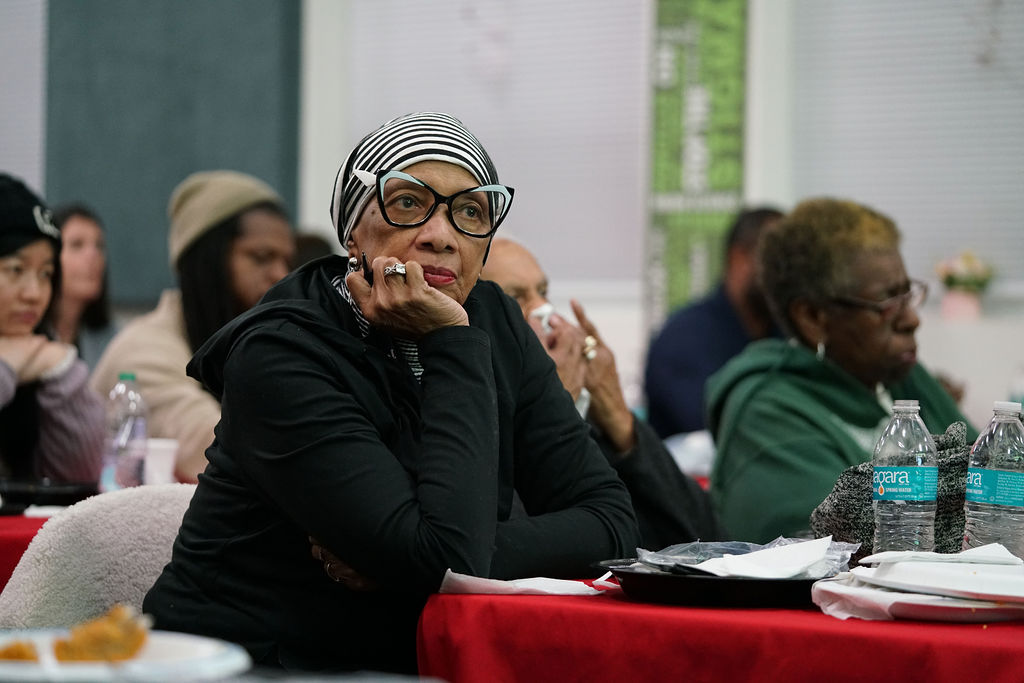
Marsh was among the panelists at last week's Every Voice, Every Vote's third installment of its Community Conversations series, which took place at Episcopal Community Services in West Philadelphia and drew nearly 50 attendees.
Public safety was the topic of discussion for the Feb. 26 event, particularly how Philadelphians feel about the issues of crime and safety as well as efforts by the administration of Mayor Cherelle Parker to address them.
Philadelphia is not the only U.S. city to experience decreases in homicides and other violent crimes in the years following a nationwide surge and peak in 2021.
However, the city has seen some of the steepest declines in violent crime since then compared to other large cities, including in its number of shootings. Adam Garber, CEO of gun-violence prevention advocacy group CeaseFirePA, said government funding for community violence intervention groups has been the driving factor.
Garber said prior to 2020, the total amount of Pennsylvania state funding invested in these groups has been less than $5 million. But from 2020 to 2024, that total figure has exceeded $300 million, including about $50 million for groups based in Philadelphia.
Many of these organizations operated on shoestring budgets or were purely volunteer, Garber said in an interview following the panel. “And then we finally invested in them and they had success. That’s why you're seeing these historic lows, not just a post-pandemic return to normal.”
Community groups are not working in silos but forging stronger ties with the Philadelphia Police Department, panelists said.
Adara Combs, who leads the Office of the Victim Advocate at City of Philadelphia, said compared to a decade ago, police today are much more interested in connecting with violence intervention groups. She also said city officials host a weekly Zoom meeting for police leaders and community leaders, which helps all parties get ahead of issues.
"I think they're recognizing that it takes a holistic approach to address what's going on in our communities,” Combs said about police, “and it can't just be solved through them."
Mensah Dean, senior writer at gun violence publication The Trace, said his reporting and conversations indicate that “police want the help,” when it comes to violence prevention groups. But they aren’t too fond of those with little or no Philadelphia roots,
“My observation is that police are more amenable to embracing community organizations that are homegrown. They really don't like the outsiders.”
Deion Sumpter, deputy director of violence prevention initiatives with the Office of Safe Neighborhoods at the City of Philadelphia, said he worked extensive hours during the crime surge in the early 2020s. This included working to help understaffed violence intervention groups combat the problem.
He’s proud to see the recent reductions in violent crime, he said, but it’s still hard to shake the scale of the trauma that happened.
“The impact of those 562 people that we lost in 2021, we're still feeling that same feeling today,” Sumpter said. “This is the aftermath of it, you know. It feels similar to coming home from war, where many people carry the trauma of what they experienced.”